
Recovering from a chronic stroke requires more than traditional rehabilitation; it demands a specialized environment that challenges the neurological system while providing safety. At HydroWorx, we understand that regaining mobility is a complex journey of neuroplasticity and physical endurance. By leveraging the unique properties of water, we offer an advanced methodology to neurological repatterning. Our technology is designed to help patients move beyond the limitations of land-based therapy, focusing specifically on restoring the natural mechanics of walking. Through precise aquatic intervention, we empower individuals to reclaim their independence and improve their overall quality of life.
The Power of Forced Gait Symmetry
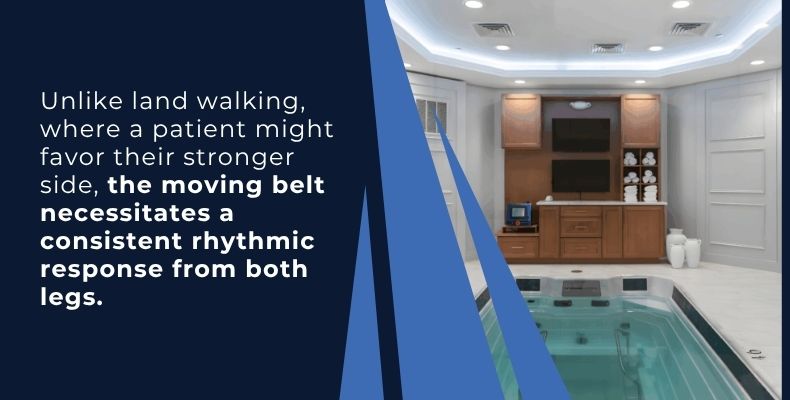
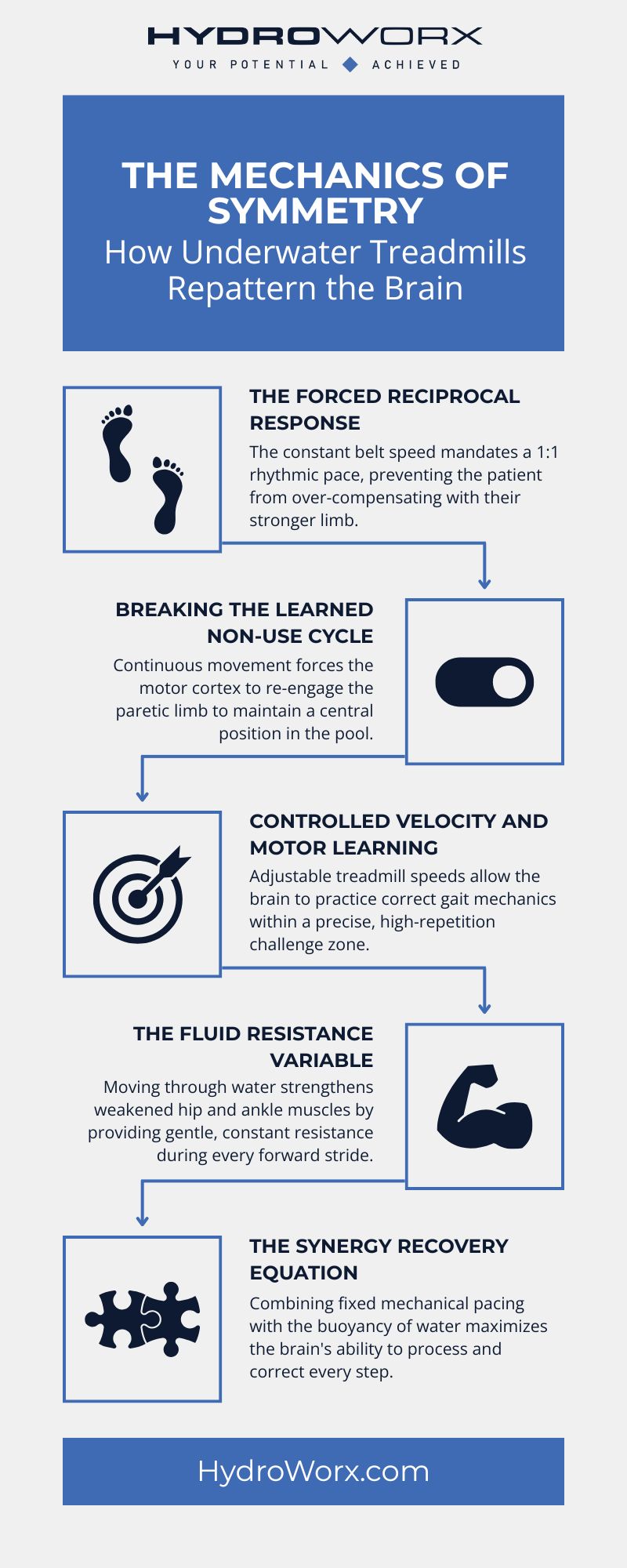
The constant speed of our integrated underwater treadmill plays a vital role in correcting gait asymmetries often seen after a stroke. Unlike land walking, where a patient might favor their stronger side, the moving belt necessitates a consistent rhythmic response from both legs. This environment forces the paretic limb to engage more actively to keep pace with the treadmill. By eliminating the ability to over-compensate with the unaffected side, patients can re-establish a balanced walking pattern. This consistent repetition is essential for retraining the motor cortex and ensuring that both limbs contribute equally to locomotion.
To achieve true gait symmetry, we utilize several key features of the treadmill environment:
- Constant Belt Speed: Removes the patient’s ability to stutter-step or hesitate, requiring a continuous reciprocal motion.
- Visual Feedback: Patients can watch their stride in real-time via underwater cameras, aligning their mental map with physical reality.
- Adjustable Resistance: We can increase the workload on the paretic limb specifically to build strength where it is needed most.
- Rhythmic Auditory Stimulation: Matching the treadmill speed to a beat helps the brain lock in to a symmetrical pattern.
Buoyancy and Neural Processing Time
One of the greatest hurdles in stroke recovery is the rapid pace of land-based movement, which often outpaces the brain’s damaged signaling. In the water, buoyancy reduces the effects of gravity, effectively slowing down the falling phase of a step. This extra time is critical; it allows the brain the necessary window to process sensory feedback and execute motor commands correctly. We find that this increased duration for each stride helps patients focus on their alignment and foot placement. Consequently, the neurological system has the space to rebuild pathways that may have been dormant since the injury.
This slowed-down environment provides several neurological advantages:
- Extended Stance Phase: Gives the patient more time to feel the ground and stabilize before transitioning to the next step.
- Reduced Impact: Lowering the stress on joints allows for longer therapy sessions without the fatigue common in land rehab.
- Deliberate Cognitive Engagement: Patients can consciously think through the mechanics of heel-to-toe movement.
- Error Correction: If a step is misplaced, the slow-motion nature of the water allows the patient to correct it mid-motion.
Proprioceptive Feedback in the Aquatic Environment
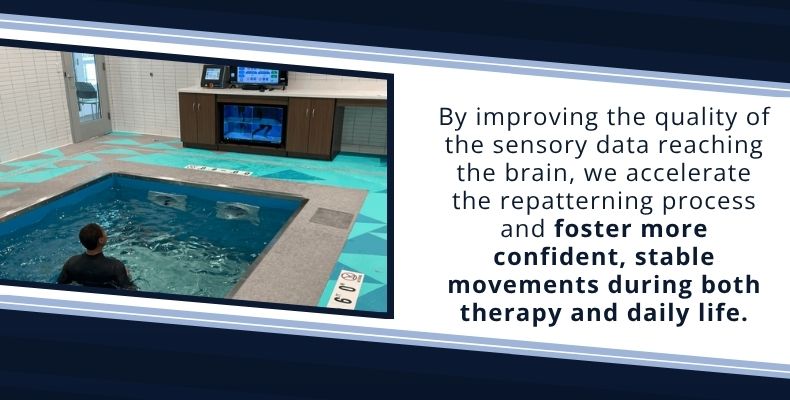
Hydrostatic pressure provides constant, uniform tactile input across the entire submerged body, which significantly enhances a patient’s proprioception or body awareness. For individuals who have lost the feel of their limb’s position, this deep pressure acts as a continuous sensory map. We utilize this feedback to help patients better understand where their legs are in space during the gait cycle. This heightened sensory environment makes every movement more intentional. By improving the quality of the sensory data reaching the brain, we accelerate the repatterning process and foster more confident, stable movements during both therapy and daily life.
We maximize these sensory benefits through specific aquatic protocols:
- Variable Water Depths: Adjusting the depth changes the pressure and buoyancy, challenging the brain to adapt to different sensory loads.
- Resistance Jets: Our therapy jets provide targeted tactile cues that help patients find their paretic limb during movement.
- Multi-Directional Walking: Moving sideways or backward in water provides novel sensory input that strengthens neural connections.
- Enhanced Balance Training: The viscosity of the water provides a supportive resistance that makes balance exercises safer and more effective.
Reducing Fear and Promoting Neuroplasticity
Fear of falling is a major psychological barrier that can lead to stiff, guarded movements and a plateau in recovery. Our aquatic therapy pools create a fail-safe environment where the risk of injury from a fall is virtually eliminated. When patients feel safe, their muscle tension decreases, allowing for a more natural range of motion and increased experimentation with movement. This relaxation is a catalyst for neuroplasticity, as the brain is more receptive to learning when not in a state of high stress. We see remarkable progress when patients are given the freedom to push their physical limits without fear.
Creating a psychologically safe environment leads to better clinical outcomes:
- Elimination of Bracing: Patients stop holding their breath or tensing up, which is essential for fluid, natural walking.
- Increased Intensity: Because they aren’t afraid to fall, patients are willing to walk faster and longer than they would on land.
- Confidence Building: Success in the pool translates to a can-do attitude that carries over into their land-based daily activities.
- Neuro-Chemical Boost: Reduced cortisol (stress) and increased focus create the ideal internal state for long-term brain remodeling.
Our goal is to provide the most effective tools for neurological recovery, ensuring every patient has the opportunity to regain their stride. By combining the science of hydrodynamics with advanced treadmill technology, HydroWorx provides a unique solution for those struggling with the long-term effects of a stroke. If you are looking to enhance your facility’s rehabilitation outcomes or seeking better care for your patients, we invite you to explore our research-backed equipment. Contact our team today to discuss how we can support your clinical goals.