
The recovery journey following a significant ankle injury often hinges on one critical question: Can we safely retrain a joint’s position sense in an environment that is intentionally unstable? While traditional rehabilitation often relies on static surfaces, we believe that introducing controlled turbulence is the key to unlocking superior functional outcomes. By leveraging the physics of water, we can challenge the body’s proprioceptive systems in ways that land-based exercises cannot match. This approach doesn’t just focus on strength; it focuses on the brain-body connection required for true stability.
Traditional land-based balance training often utilizes foam pads or wobble boards, but these tools can be limiting and potentially hazardous for a patient already struggling with joint confidence. When we utilize aquatic therapy for ankle instability, we remove the fear of falling while simultaneously increasing the complexity of the rehabilitative task. The density of water provides a unique form of sensory feedback—hydrostatic pressure—which envelops the limb and heightens the patient’s awareness of their ankle’s position in space. By introducing jet-driven currents, we create a live environment where the water isn’t just a support system, but an active participant in the rehabilitation process. This allows us to bridge the gap between early-stage healing and high-performance functionality, ensuring the neural pathways are fully restored before a patient ever sets foot back on the field. Keep reading to learn more from HydroWorx.
The Physics of Turbulence
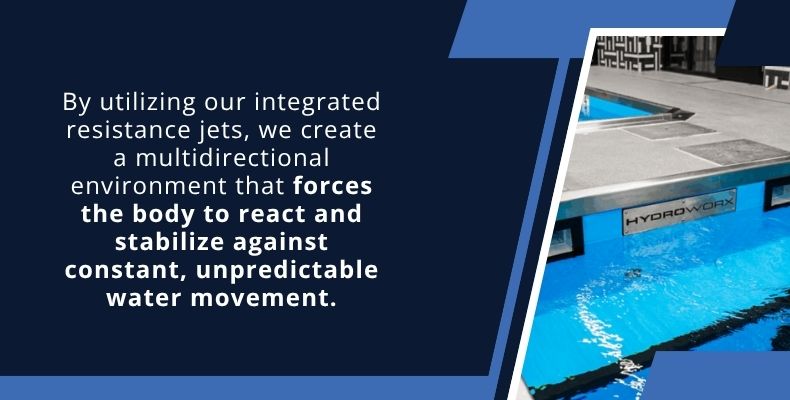
We understand the complexity of restoring joint position sense after significant ankle injuries. Traditional methods often plateau because they lack the dynamic variability found in real-world movement. However, aquatic therapy for ankle instability introduces a sophisticated element through variable turbulence. By utilizing the integrated resistance jets, we create a multidirectional environment that forces the body to react and stabilize against constant, unpredictable water movement.
Unlike land-based environments, where gravity is the primary force, the fluid dynamics of our therapy pools introduce:
- Viscous Drag: Providing constant resistance in every direction of movement.
- Unpredictable Eddies: Creating micro-bursts of pressure that challenge lateral stability.
- Perturbation Training: Allowing clinicians to manipulate water flow to knock a patient off balance safely.
This turbulent environment ensures that the patient cannot simply rely on pre-programmed motor patterns. Instead, they must remain in a state of constant, reactive adjustment, which is the cornerstone of advanced proprioceptive rehabilitation.
Challenging Mechanoreceptors
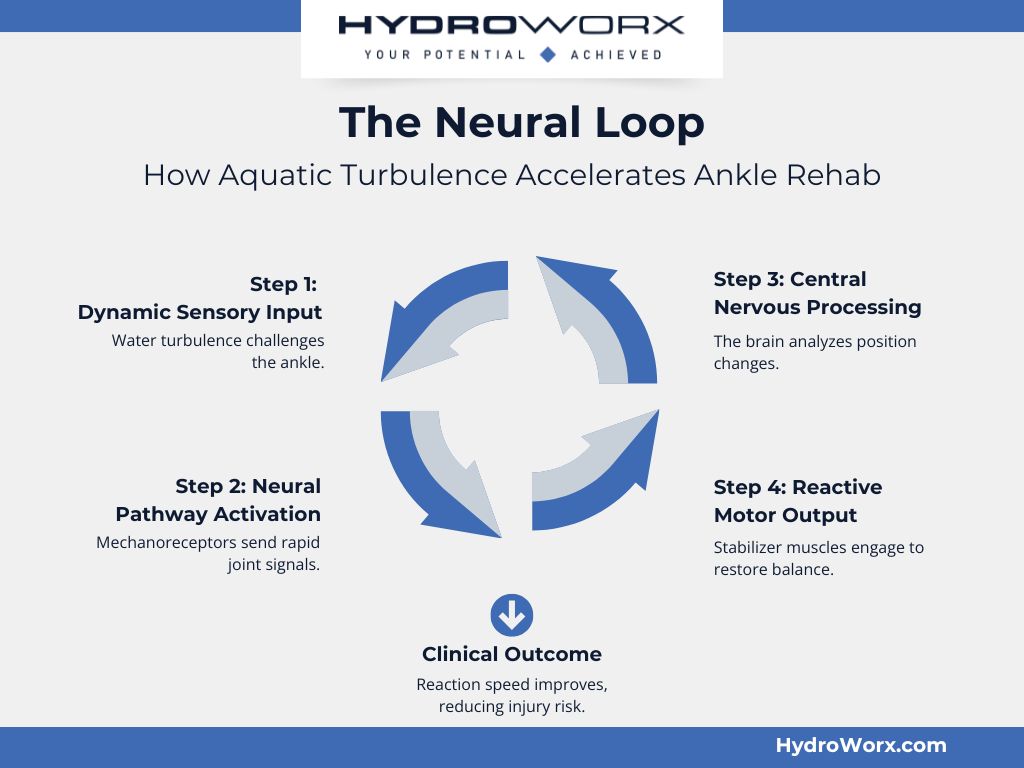
This approach focuses on stimulating the mechanoreceptors within the ankle joint using aquatic therapy. Following a ligamentous tear or severe sprain, the sensory feedback loop between the ankle and the brain is often compromised. When we engage the resistance jets, we generate currents that challenge the patient’s balance more effectively than static surfaces. This sensory input is vital for re-training the brain to recognize and correct joint positioning in real-time scenarios.
The high-density input from water molecules hitting the skin and joint capsule provides:
- Increased Proprioceptive Awareness: Forcing the nervous system to listen to the ankle’s position.
- Neuromuscular Activation: Engaging the small stabilizer muscles that often go dormant after an injury.
- Enhanced Feedback Loops: Accelerating the speed at which the brain sends corrective signals to the lower extremities.
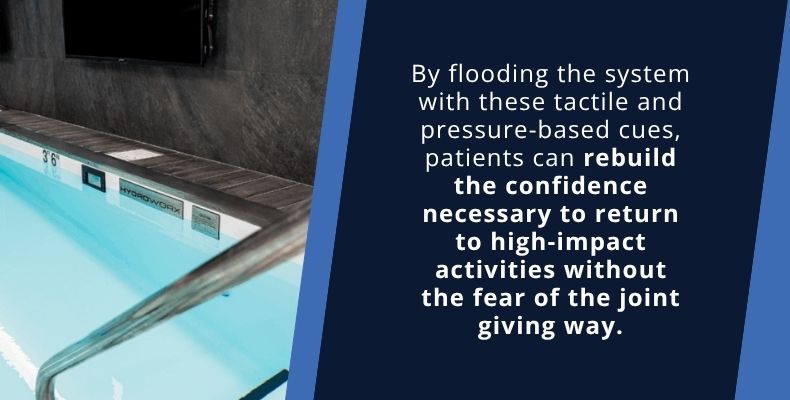
By flooding the system with these tactile and pressure-based cues, patients can rebuild the confidence necessary to return to high-impact activities without the fear of the joint giving way.
Surpassing Land-Based Limits
Comparing this to land-based foam pads, aquatic therapy offers a superior level of unpredictability. While foam provides a soft surface, it is relatively tongue-tied and operates primarily in a two-dimensional plane of instability. Conversely, the turbulent water from our jets requires constant micro-adjustments in a 360-degree radius, ensuring the proprioceptive system remains fully engaged and better prepared for the demands of athletic activity.
Furthermore, the buoyancy of water provides a unique safety net that land cannot offer:
- Reduced Impact: Patients can perform high-velocity balance drills without the risk of a secondary roll or fracture.
- Increased Range of Motion: The warmth and hydrostatic pressure of our pools allow for greater joint mobility during stability drills.
- Longer Training Durations: Because the joint isn’t being pounded by full body weight, we can extend the time spent on proprioceptive re-wiring.
This combination of high challenge and low risk allows us to push the boundaries of rehabilitation far earlier in the recovery timeline than traditional land-based protocols.
Progressive Resistance Training
Progressive loading is essential for successful rehabilitation, and our technology allows clinicians to adjust flow rates precisely. By gradually increasing jet intensity during aquatic therapy sessions, patients can safely push the limits of their stability. They don’t just stand still; patients can be challenged to walk, lung, or even perform sport-specific movements against the current.
Our progressive system allows for:
- Incremental Difficulty: Moving from 10% flow to 100% flow as the patient’s stability improves.
- Targeted Resistance: Positioning the patient to face the current or stand sideways to it, to target specific ligamentous weaknesses.
- Dynamic Loading: Simulating the cutting forces of a soccer pitch or basketball court in a controlled, buoyant setting.
This controlled environment minimizes the risk of re-injury while maximizing the functional gains achieved during recovery. By the time a patient transitions back to land, their ankle has already mastered the art of stabilizing against much more chaotic forces than they will encounter in daily life.

Mastering ankle stability requires a transition from predictable surfaces to dynamic, turbulent environments that mirror real-world stressors. By leveraging the power of resistance jets, we provide a sophisticated solution for athletes and patients to regain confidence through specialized aquatic therapy for ankle instability. Our technology at HydroWorx ensures that every session challenges the proprioceptive system safely and effectively. Contact us to learn more about our innovative pool designs.