
At HydroWorx, we design and manufacture high-performance aquatic therapy pools and underwater treadmills that utilize the unique properties of water to enhance physical conditioning. The therapeutic power of water has long been recognized for its ability to transform rehabilitation, and our mission is to provide the cutting-edge tools necessary to unlock that potential for every user. Aquatic conditioning leverages fundamental principles of physics to create a low-impact environment where the body can move with significantly greater efficiency and less pain than on land-based surfaces. By integrating advanced technology such as adjustable floors and powerful resistance jets into our equipment, we provide the essential platforms to harness these scientific benefits for truly transformative health outcomes. Whether individuals are recovering from acute injury or aiming for elite athletic performance, we believe the aquatic environment offers a versatile medium for success. Our systems are engineered to optimize every movement, ensuring the intersection of science and hydrotherapy leads to wellness.
The Impact of Buoyancy on Joint Load
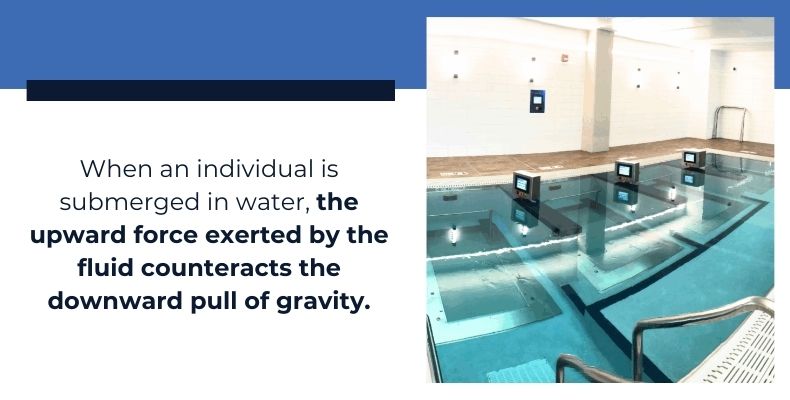
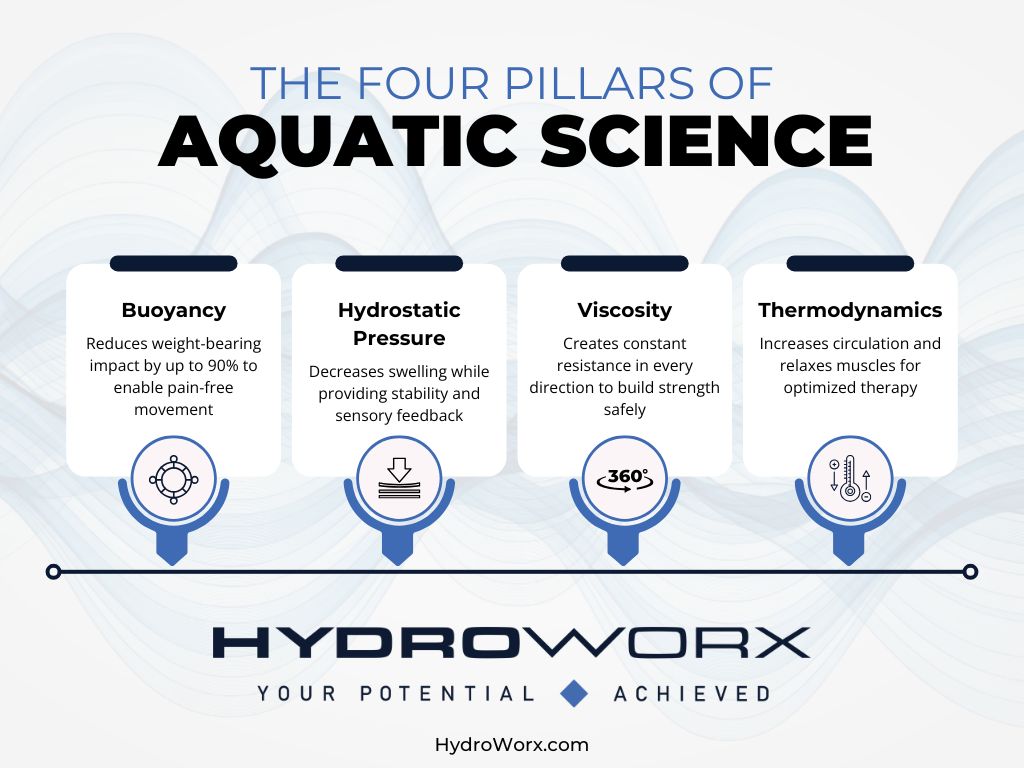
Buoyancy is a fundamental principle of fluid mechanics, defined by Archimedes’ Principle, which significantly alters the physical experience of movement by reducing the effective weight of the human body. When an individual is submerged in water, the upward force exerted by the fluid counteracts the downward pull of gravity. This gravity-lite environment preserves joint integrity while allowing for the maintenance of muscle mass and cardiovascular health, bridging the gap between total rest and full-impact activity. The degree of weight reduction is directly proportional to the level of immersion:
- Waist-deep immersion: Reduces weight-bearing by approximately 50%.
- Chest-deep immersion: Reduces weight-bearing by approximately 75%.
- Neck-deep immersion: Can reduce weight-bearing by up to 90%.
This phenomenon is critical for aquatic conditioning because it allows for early-stage mobilization that would be impossible on land. By offloading the joints, water enables patients with specific restrictions to engage in gait training and functional movements without the risk of high-impact trauma. This is particularly beneficial for:
- Individuals with osteoarthritis or degenerative joint disease.
- Athletes recovering from stress fractures.
- Patients with strict post-surgical weight-bearing restrictions.
Leveraging Hydrostatic Pressure for Recovery
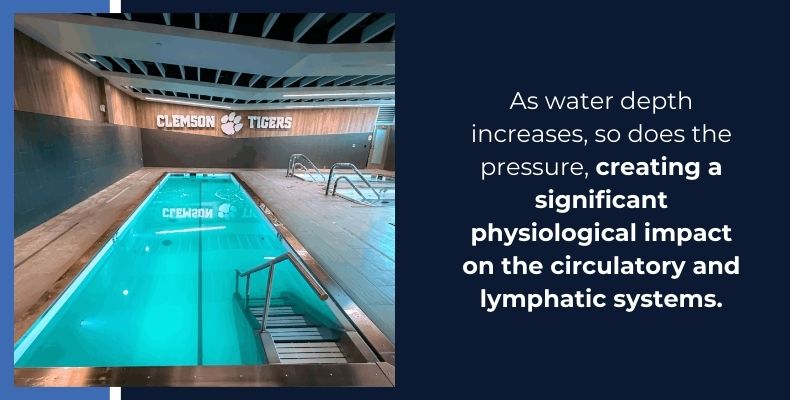
Hydrostatic pressure is the force exerted by water molecules against every submerged surface of the body, following Pascal’s Law, which states that fluid pressure is exerted equally in all directions. This uniform compression acts as a natural support system, particularly for the lower extremities. As water depth increases, so does the pressure, creating a significant physiological impact on the circulatory and lymphatic systems. This pressure assists in the recovery process through several mechanisms:
- Edema Reduction: The pressure assists in the reduction of swelling by facilitating venous return and pushing fluids from the extremities back toward the heart.
- Enhanced Proprioception: The constant sensory input provided by hydrostatic pressure improves the body’s ability to sense its position in space.
- Postural Support: The surrounding pressure creates a stable environment that supports the torso during movement.
This is especially beneficial for individuals recovering from neurological impairments or ligamentous injuries, as the water provides a stable, supportive feel that boosts confidence during balance exercises. By promoting efficient circulation and providing tactile feedback, hydrostatic pressure accelerates the recovery timeline and improves overall movement quality.
Resistance Training Through Water Viscosity
Movement in water is inherently more challenging than movement in air due to water’s higher viscosity and the resulting drag forces. Because water is roughly 800 times denser than air, every gesture meets a constant, surrounding force. This creates a unique training environment where the resistance is accommodating, meaning it is perfectly proportional to the effort exerted by the user. Key characteristics of this resistance include:
- Multidirectional Loading: Unlike land-based resistance, which is often unidirectional, aquatic resistance occurs throughout the entire range of motion and in every direction of movement.
- Variable Intensity: The faster a person moves, the greater the resistance becomes, allowing for safe, progressive loading.
- Muscle Balance: Utilizing the viscous properties of the fluid builds balanced strength across opposing muscle groups, enhancing functional stability.
This allows for strength building without the eccentric jarring associated with traditional weightlifting, which often leads to delayed onset muscle soreness (DOMS). By harnessing these properties, aquatic conditioning builds power in a way that minimizes the risk of overexertion or muscle strain, making it an ideal environment for both rehabilitating injuries and developing elite-level athletic performance.
Thermodynamics and Improved Circulation
The thermodynamic properties of water, specifically its high specific heat and thermal conductivity, play a vital role in the conditioning process. Water is remarkably efficient at transferring heat to and from the body, far surpassing the capabilities of air. In a controlled aquatic environment, warm water acts as a potent vasodilator, causing blood vessels to expand. This thermal regulation ensures that the musculoskeletal system is properly warmed up and receptive to exercise, creating a therapeutic atmosphere that optimizes physical output. Significant benefits of this thermal exchange include:
- Increased Blood Flow: Influx of oxygenated blood promotes tissue elasticity and accelerates the removal of metabolic waste like lactic acid.
- Analgesic Effect: Thermal stimulation influences the pain gate theory, helping to sedate sensory nerve endings and reduce muscle spasms.
- Improved Flexibility: Warmth helps to relax connective tissues, allowing for a greater range of motion and more intensive stretching.
These effects create an environment that prepares the body for more intensive movements while minimizing the risk of re-injury. By utilizing the specific heat of water, practitioners can manipulate the environment to either soothe chronic pain or prepare an athlete for high-intensity intervals, ensuring the body remains in an optimal state for physical conditioning.

The science of aquatic conditioning offers unparalleled advantages for recovery and athletic development through the synergy of buoyancy, pressure, and resistance. By understanding these physical laws, we can better appreciate how water-based exercise improves long-term outcomes for various populations. HydroWorx provides the advanced aquatic technology required to implement these scientific principles effectively in any facility. We invite you to explore our various pool models to see the technology in action or download our latest research to learn how these solutions can benefit your specific goals.