
Recovering from hip replacement surgery can be a long and frustrating process. Most people endure hip replacement surgery inorder to reduce pain and to return to activities they love. Unfortunately, the rehabilitation process is volatile and can leave patients frustrated with their progress. Although the process seems endless, it is an important piece of regaining joint mobility and getting back to normal function again.
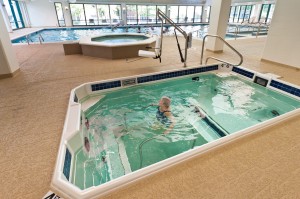
Benefits of Aquatic Therapy After Hip Replacement
Aquatic therapy can offer some distinct advantages to those recovering from hip surgery. Not only does it add variety to standard land therapy, it has been shown to enhance recovery. Here are a few ways that aquatic rehabilitation can benefit hip replacement patients:
Reduced fear of falling
The aquatic environment offers the security of falling without consequence. One of the difficult things after hip replacement surgery is feeling comfortable on your own two feet again. By working on and mastering skills in the water first, patients will feel more confident in their abilities once they try to perform them on land.
Decreased inflammation
The warm water and hydrostatic pressure promotes circulation which helps to decrease pain and inflammation. This helps to increase mobility and decrease scar tissue as well.
Reduced joint stress
The buoyancy of water allows a patient to reduce their bodyweight by up to 80%, thus removing pressure on healing joints. As a patient’s rehab progresses, water depth can be adjusted to slowly increase bodyweight.
Increased strength and range of motion
The properties of water create an environment that allows patients to increase their range of motion, often more quickly than on land. The viscosity of the water provides natural resistance to movements which provides muscle strengthening. The resistance can be increased by using the jets to progress patients further.
Reduced side effects
Because of the positive effects of the water, such as improved mobility, circulation, strength, flexibility and balance, patients will typically experience fewer side effects from the rehabilitation. Pain is often less noticeable after an aquatic therapy session while strains and over-stress are often avoided.
Improved posture
In the water, clinicians can identify and correct any postural issues which may affect the healing joint(s), or may have come from overcompensation of the painful joint. Once identified, patients can confidently correct any postural issues in the reduced-pain environment and can then carryover these corrections to land. Gait patterns can easily be monitored with underwater video cameras. Patients are able to quickly fix any problems by watching themselves on screen in real-time.
Download The Arthritis & Joint Replacement Tip Sheet
Download the Arthritis and Joint Replacement tip sheet for more information on how aquatics can benefit your patients.>>
Request a Free Info Kit View Our Products Find a Pool Near You