
As pickleball continues its explosive growth across the country, players of all skill levels are spending more time on the court than ever before. However, the game’s fast pace, sudden transitions, and frequent side-to-side movements create significant physical stress on the lower body. Rapid lateral deceleration—the sudden stop or shift in direction required to reach an unexpected kitchen shot or dink—places immense force on the knees, ankles, and plantar fascia. Without proper conditioning and kinetic control, these repetitive high-impact stops often lead to common issues like patellar tendonitis, ACL strains, plantar fasciitis, and ankle sprains.
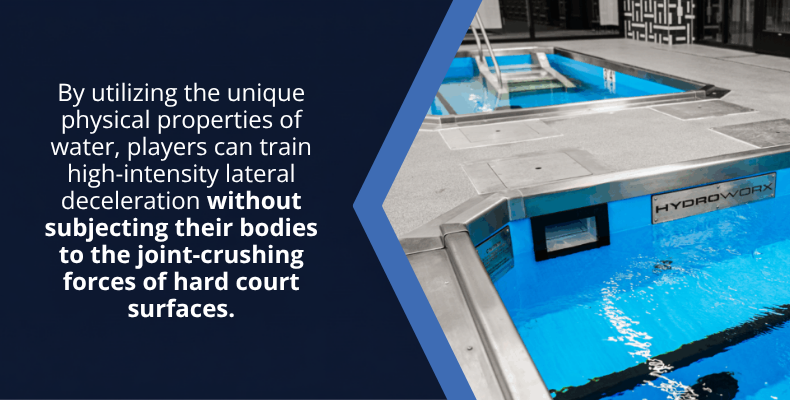
At HydroWorx, we believe that staying active and competitive shouldn’t mean constantly battling joint pain or soft tissue injuries. Integrating targeted aquatic therapy into a training regimen provides athletes and recreational players with a low-impact environment to build strength, refine footwork, and protect their joints. By utilizing the unique physical properties of water, players can train high-intensity lateral deceleration without subjecting their bodies to the joint-crushing forces of hard court surfaces.
Underlying Causes of Lateral Deceleration Injuries in Pickleball
The biomechanics of pickleball require explosive acceleration followed immediately by abrupt stopping forces. When a player plants their foot hard to change direction during lateral tracking, thousands of pounds of ground reaction force translate directly upward through the ankle, knee, and hip joints. On a standard hard court, this kinetic energy has nowhere to go except into the athlete’s cartilage, tendons, and ligaments. Over time, repetitive deceleration strains the patellar tendon, overworks the stabilizer muscles around the ankle, and microtears the plantar fascia. Furthermore, when fatigue sets in during long matches, a player’s landing mechanics degrade, increasing the likelihood of acute ligament tears or severe joint inflammation. Understanding how these mechanical forces impact the lower body is the first step toward building a resilient physique.
- Ground Reaction Forces: Hard court surfaces offer zero shock absorption during hard stops, sending force straight to joints.
- Rotational Torque: Quick directional changes create severe twisting forces across the knee joint and patellar tendon.
- Ankle Instability: Unprepared lateral shifts push ankles into extreme inversion, increasing the risk of sprains.
- Fascial Strain: Continuous quick-start and hard-stop motions overload the plantar fascia beneath the foot.
Why Aquatic Environments Excel for Deceleration Retraining
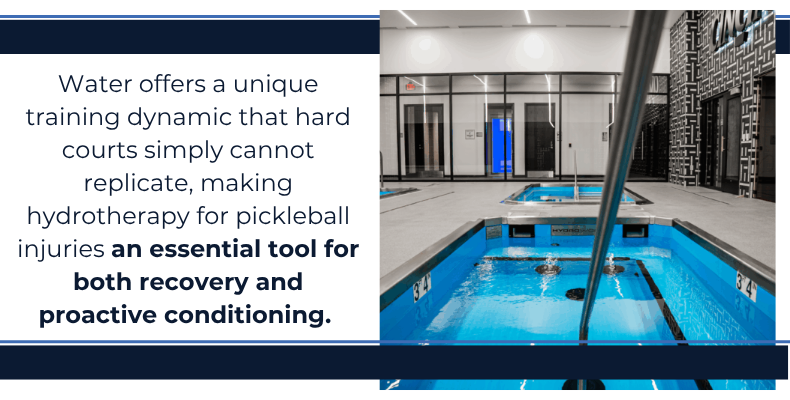
Water offers a unique training dynamic that hard courts simply cannot replicate, making hydrotherapy for pickleball injuries an essential tool for both recovery and proactive conditioning. Due to buoyancy, submerging a player to chest depth reduces their effective body weight by up to 80%, dramatically diminishing the impact forces sent through the feet and knees during abrupt stops. Simultaneously, water provides 360-degree multidirectional resistance, meaning every lateral step forces the stabilizer muscles around the hips, knees, and ankles to work harder without the danger of harsh ground impact. This combination allows athletes to practice high-velocity footwork, train muscle memory, and improve deceleration mechanics in a safe, controlled environment. By taking the impact out of the equation, players can perform higher training volumes with minimal joint inflammation or post-workout soreness.
- Buoyancy Advantage: Reduces body-weight load by up to 80%, eliminating heavy joint impact during hard stops.
- Viscous Resistance: Engages core and lower-body stabilizers in all planes of motion simultaneously.
- Hydrostatic Pressure: Reduces swelling in lower extremities while increasing circulation during movement.
- Controlled Velocity: Allows players to practice rapid footwork mechanics with a zero-fall, soft-landing environment.
Targeted Underwater Footwork Drills for Knee and Foot Stability
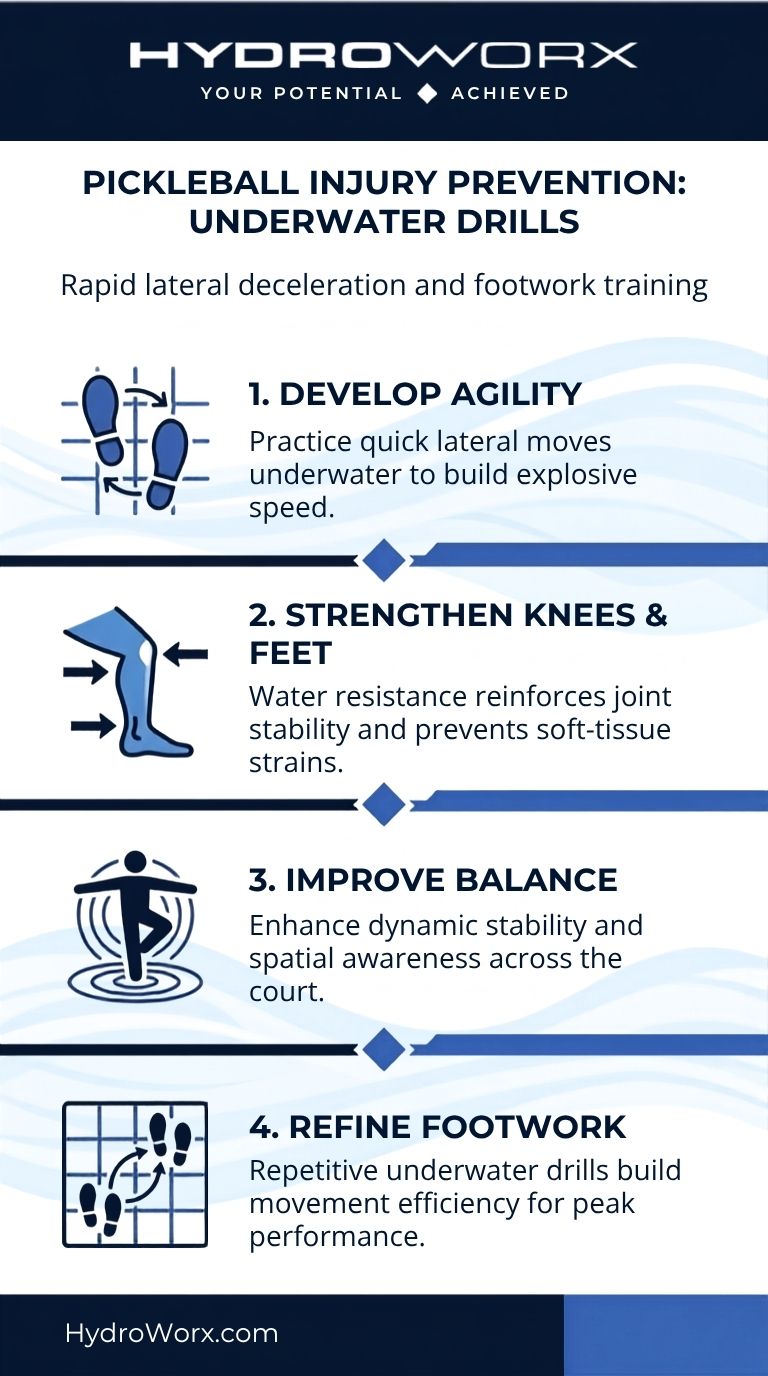
To specifically combat the forces responsible for lower-limb trauma, we utilize structured underwater drills designed to mimic the exact movement patterns required on the court. Using an underwater treadmill combined with resistance jets allows us to recreate the intense lateral demands of pickleball while preserving joint integrity. Exercises such as lateral shuffle-stops focus on training the quads and glutes to absorb kinetic energy efficiently during a side-step. Crossover deceleration drills enhance hip mobility and ankle stabilization, teaching the body to maintain alignment under load. Additionally, backward-to-lateral transition steps build reactivity in the calves and foot arches, fortifying the plantar fascia against sudden stretching forces. Performing these drills systematically builds neuromuscular control, allowing players to execute sharp court movements automatically and safely when returning to competitive play.
- Lateral Shuffle-to-Stop: Shuffling across the pool floor against jet resistance, planting the outside foot firmly to absorb force.
- Crossover Deceleration Steps: Moving sideways with alternating crossover steps to train rotational knee stability and hip engagement.
- Single-Leg Water Bounding: Jumping laterally from one foot to the other, focusing on soft landings and ankle alignment.
- Backward-to-Lateral Transitions: Simulating overhead smash tracking by dropping back quickly and planting into a side push-off.
Integrating Hydrotherapy into Your Long-Term Training Routine
Preventing court injuries isn’t just about rehabilitating after an acute sprain occurs; it requires a proactive approach to physical longevity. Incorporating regular aquatic treadmill sessions into a weekly training split allows pickleball enthusiasts to maintain cardiovascular endurance and sharp footwork while giving their joints a much-needed break from hard surfaces. For players recovering from existing knee or foot conditions, water-based movement provides an early, pain-free entry point back into sports-specific conditioning long before hard-court practice is safe. At HydroWorx, our advanced aquatic therapy pools feature integrated underwater treadmills, adjustable resistance jets, and video monitoring tools designed to optimize athletic performance and speed up recovery times. By prioritizing joint health through water-based deceleration training, you can protect your lower body, enhance your agility on the court, and extend your playing career for years to come.
Maintaining long-term success on the pickleball court requires balancing high-intensity play with smart injury prevention strategies. By addressing the root biomechanical causes of lateral deceleration injuries through aquatic training, players can build lower-body strength, improve joint stability, and protect their knees and feet from chronic wear and tear. At HydroWorx, our advanced aquatic therapy solutions empower athletes and active individuals to move without pain, recover faster, and train more effectively. Whether you are recovering from a recent lower-body strain or looking to enhance your lateral agility before your next tournament, water-based conditioning offers an unbeatable path forward. Explore our innovative aquatic pool systems today to see how HydroWorx can transform your performance and recovery routine, or contact our team to learn more about bringing hydrotherapy solutions to your facility or training program.