
For dedicated female athletes over 40, performance, recovery, and long-term joint health become closely linked to ongoing hormonal shifts. As systemic estrogen levels naturally decline during perimenopause and menopause, many active women experience sudden joint stiffness, chronic micro-swelling, and reduced tissue elasticity that make traditional, high-impact land training increasingly painful. At HydroWorx, we believe that midlife hormonal transitions should never force an athlete to step away from the sport, competitive edge, or active lifestyle she loves. Water-based conditioning provides a scientifically supported training medium that drastically reduces mechanical strain on sensitive joint structures while fully preserving cardiovascular capacity, muscular power, and overall athleticism. By moving high-intensity metabolic sessions into an advanced aquatic environment, seasoned female athletes can effectively manage hormonal inflammation, sustain higher training volume, and continue competing at their absolute best without compromising their long-term structural health.
Understanding the Hormonal Connection to Midlife Joint Inflammation
Estrogen plays a vital, often understated role in maintaining connective tissue hydration, cartilage resilience, and systemic inflammatory balance throughout the female body. As estrogen production fluctuates and drops during perimenopause and menopause, collagen synthesis decreases, ligaments lose elasticity, and natural synovial fluid production declines. For the active female athlete, these biological shifts manifest as persistent aching, reduced range of motion, and lingering discomfort in high-load joints like the knees, hips, shoulders, and spine.
- Estrogen & Tissue Elasticity: Declining hormone levels reduce structural collagen density, making tendons and ligaments stiffer and more prone to micro-tears during eccentric loading.
- Synovial Fluid Reduction: Less joint lubrication leads to elevated friction within the joint capsule, increasing post-workout swelling and localized heat.
- Systemic Inflammatory Response: Lower estrogen levels can trigger systemic cytokine release, causing generalized body aches that take significantly longer to clear after heavy training sessions.
- Hydrostatic Pressure Benefits: Aquatic therapy applies continuous, fluid compression directly across swollen limbs, actively facilitating lymphatic drainage and pushing cellular waste out of compromised joint capsules.
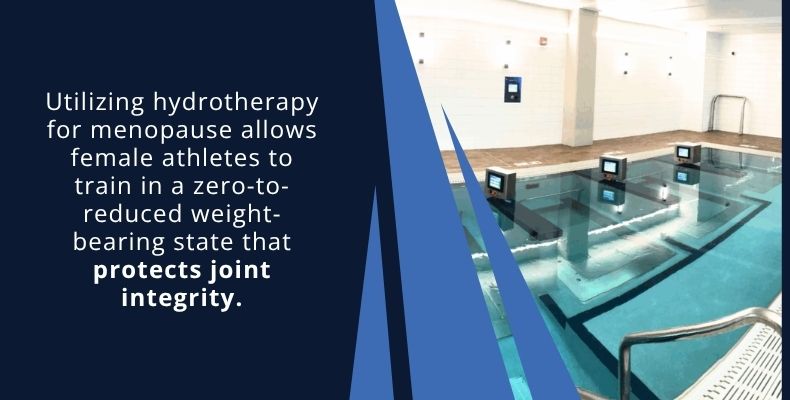
Rather than pushing through high-impact ground stress that exacerbates cartilage wear, utilizing hydrotherapy for menopause allows female athletes to train in a zero-to-reduced weight-bearing state that protects joint integrity while facilitating fluid, pain-free athletic movement.
Restoring High-Performance Conditioning Through Hydrotherapy for Menopause
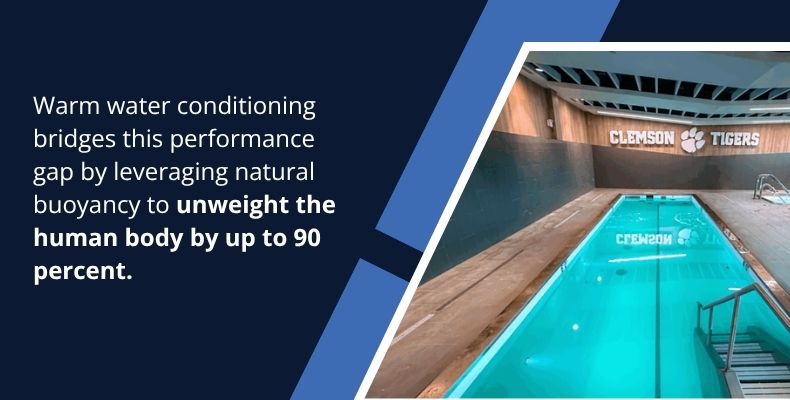
Maintaining athletic power, speed, and cardiovascular endurance during midlife requires ongoing access to intense exercise stimulus, yet land-based impact often forces unwanted rest days due to joint pain. Warm water conditioning bridges this performance gap by leveraging natural buoyancy to unweight the human body by up to 90 percent. Inside our advanced aquatic environments, athletes can execute explosive movements, full-stride sprint mechanics, and agility drills without exposing sensitive joint structures to destructive gravitational loading.
- Buoyancy Unweighting: Exercising in chest-deep water reduces joint impact by up to 90%, allowing athletes to train hard without joint compression.
- Variable Dynamic Resistance: Water provides 360-degree progressive resistance; as movement velocity increases, muscle engagement ramps up automatically without needing heavy external weights.
- Neuromuscular Retention: Aquatic treadmills allow midlife runners and field athletes to keep their full stride rate and neuromuscular firing patterns active without triggering stress fractures or tendinitis.
- Cardiovascular Maintenance: Full-body water circuits drive heart rates into high-intensity metabolic zones, keeping VO2 max elevated while keeping joint surfaces completely protected.
This unique combination allows female athletes over 40 to hit key heart rate zones, build functional strength, and maintain peak physical conditioning without causing post-exercise inflammatory flare-ups.
Enhancing Joint Mobility and Accelerating Active Recovery
Structural stiffness during perimenopause often alters baseline biomechanics, leading to altered movement patterns and an increased risk of secondary overuse injuries. Thermal regulation in warm aquatic therapy environments relaxes tight musculature, enhances soft tissue elasticity, and promotes systemic arterial vasodilation, delivering nutrient-dense oxygen directly to fatigued joint tissues.
- Thermal Soft-Tissue Prep: Warm water immersion increases tissue temperature, enhancing muscle extensibility and instantly relieving morning joint stiffness.
- Restoration of Full Range: Buoyancy allows athletes to work through deep, restricted ranges of motion—such as full squats or overhead rotations—without pain or muscle guarding.
- Active Metabolic Flushing: Target underwater resistance jets stimulate superficial micro-circulation, accelerating the clearance of metabolic waste after intense conditioning blocks.
- Cortisol & Stress Reduction: Warm water immersion helps downregulate sympathetic fight-or-flight responses, lowering elevated midlife stress hormones and activating parasympathetic recovery pathways.
Long-Term Athletic Longevity and Joint Preservation Strategies
Staying competitive and resilient past age 40 requires an intelligent evolution of training methodologies that respect changing physiological realities. Integrating water-based conditioning into a weekly cross-training split prevents cumulative joint wear while sustaining lean muscle mass, joint stability, and operational confidence through controlled, resistance-rich aquatic movement.
- Proactive Load Management: Replacing 1–2 heavy land sessions each week with underwater treadmill workouts drastically cuts cumulative skeletal impact while maintaining fitness volume.
- Multi-Planar Muscle Activation: Moving against fluid resistance targets stabilization muscles around the hips, core, and shoulders that often get neglected in linear land training.
- Safe Strength Maintenance: Integrated aquatic treadmills and jet systems allow athletes to simulate heavy resistance training without exposing the spine or knees to heavy axial load.
- Lifelong Athletic Participation: Adapting to aquatic training gives midlife women the tools to navigate hormonal shifts smoothly, protecting their joints for decades of continued sport participation.
Our underwater treadmills and customized fluid environments empower female athletes to execute sport-specific movement patterns with precise form, building robust stabilization around vulnerable joint capsules. Embracing aquatic technology empowers midlife women to redefine their athletic potential, turning hormonal transitions into an opportunity for intelligent training, joint preservation, and uninterrupted performance.

Navigating perimenopause and menopause does not mean compromising your athletic goals or settling for persistent joint pain. By integrating hydrotherapy for menopause into your weekly conditioning regimen, you can actively suppress joint inflammation, preserve functional muscle strength, and protect cartilage while continuing to push your performance limits. At HydroWorx, our advanced aquatic therapy pools and integrated underwater treadmill systems are engineered to help athletes of all ages train harder, recover faster, and move without pain. To learn more about how HydroWorx can transform your conditioning and joint health, explore our clinical research or contact our team today to find the ideal aquatic solution for your training needs.