
Parkinson’s disease (PD) is a progressive neurodegenerative disorder that profoundly impacts motor control, movement initiation, and postural reflex alignment. For neurological physical therapists and movement disorder specialists, managing the hallmark motor symptoms of Parkinson’s—specifically postural instability, muscle rigidity, bradykinesia (slowness of movement), and freezing of gait (FOG)—presents a continuous clinical challenge.
On land, the fear of falling often creates a vicious cycle: as balance declines, patients become hesitant, shortening their strides and tightening their posture, which paradoxically increases their fall risk and accelerates functional decline. Integrating aquatic therapy into comprehensive neurological rehabilitation programs offers clinicians a powerful, safe environment to break this cycle.
At HydroWorx, our advanced therapy pools and underwater treadmill systems leverage the unique physics of water to eliminate fall anxiety, allowing Parkinson’s patients to practice dynamic gait drills, large-amplitude movements, and balance recovery strategies with complete confidence.
Pathophysiology of Parkinson’s Gait, Rigidity, and Movement Deficits
Parkinson’s disease‘s primary pathology stems from the degeneration of dopamine-producing neurons in the substantia nigra, leading to disrupted basal ganglia circuitry. Because the basal ganglia play a central role in modulating automatic movement sequences, motor planning, and postural adjustments, patients experience a gradual breakdown in fluid locomotion.
Clinically, this presents as shuffling gait steps, reduced arm swing, forward-stooped posture, and impaired axial trunk rotation. As the disease advances, postural instability worsens due to delayed reactive postural adjustments. Additionally, hypertonia and lead-pipe or cogwheel muscle rigidity create persistent axial stiffness. The most disabling phenomenon for many patients is “freezing of gait”—a sudden, brief inability to start walking or continue moving forward, often occurring when navigating doorways, turning around, or encountering environmental obstacles. On land, freezing creates a terrifying sensation of feet being glued to the floor while the upper body continues forward, frequently resulting in severe falls and injury.
Eliminating Fall Risk: Water as a Safe Dynamic Testing Ground
The primary barrier to aggressive balance and gait retraining on land is the high risk of catastrophic falls. When patients are fearful, they instinctively adopt guarded, small-amplitude movement strategies that reinforce neurological deficits. Immersion in a HydroWorx therapy pool immediately alters this psychological and physical dynamic through hydrostatic pressure and buoyancy.
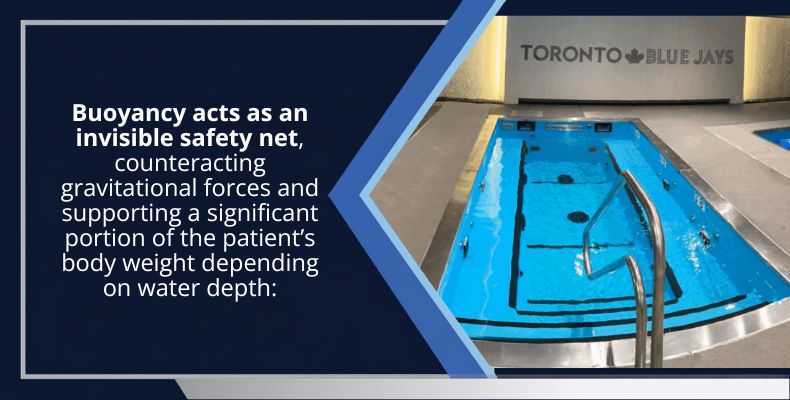
Buoyancy acts as an invisible safety net, counteracting gravitational forces and supporting a significant portion of the patient’s body weight depending on water depth:
-
Chest-Deep Immersion: Reduces gravitational load by approximately 75%, slowing down body displacement and providing ample reaction time during balance loss.
-
Hydrostatic Stabilization: Continuous, 360-degree ambient water pressure provides continuous somatosensory feedback, grounding the patient and enhancing spatial body perception.
In this buoyant environment, the immediate risk of falling is virtually eliminated. Water provides gentle, supportive drag that slows down rapid falls, giving the patient time to execute reactive stepping responses without the fear of hitting a hard floor. This newfound psychological safety empowers individuals with Parkinson’s to step outside their comfort zone, explore their limits of stability, and perform large-amplitude dynamic balance drills that would be far too dangerous to attempt on land without multiple spots or body-weight support harnesses.
Overcoming Freezing of Gait via Underwater Cueing and Treadmill Speeds
Re-educating the nervous system to overcome freezing of gait requires external sensory cueing and forced-use locomotion to bypass the damaged basal ganglia pathways. HydroWorx underwater treadmill systems provide neurological clinicians with dual-action tools—forced pacing and visual cueing—to target gait freezing effectively.
The continuous, motor-driven movement of an underwater treadmill acts as an external mechanical pace-setter. Because the treadmill belt maintains a constant, controlled speed, it forces the patient to maintain a rhythmic stepping cadence, overriding the internal sensory deficit that causes shuffling and hesitation. Furthermore, clinicians can utilize integrated visual cues on the treadmill surface or project line targets to encourage high-stepping and longer stride lengths.
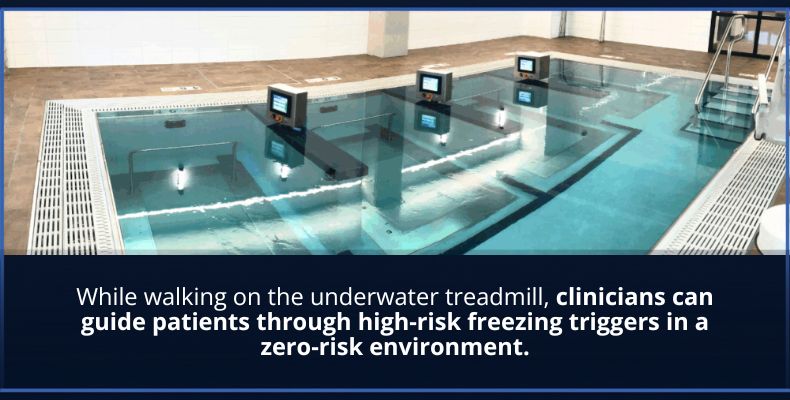
While walking on the underwater treadmill, clinicians can guide patients through high-risk freezing triggers in a zero-risk environment:
-
Tight Turning Mechanics: Practicing 180-degree and 360-degree pivot turns in chest-deep water to desensitize the neurological trigger for freezing during directional changes.
-
Dual-Tasking Drills: Combining underwater walking with cognitive tasks (e.g., counting backward or naming objects) or motor tasks (e.g., carrying a target) to build neural resilience against dual-task freezing.
-
Large-Amplitude Stepping: Utilizing buoyancy to practice exaggerated “PWR!” (Parkinson Wellness Recovery) movement concepts, encouraging high-knee marches and wide-base strides.
Combining Water Jets and Hydromassage for Rigid Muscle Relaxation
Axial rigidity and muscle tightness severely restrict the spinal rotation necessary for a smooth, natural gait. Before engaging in dynamic walking drills, clinicians can utilize warm water immersion combined with directional water jets to address muscle stiffness at a physiological level.
HydroWorx pools are typically maintained at warm, therapeutic temperatures (88°F to 92°F), which promotes systemic vasodilation, increases tissue temperature, and lowers resting muscle tone. Integrated directional resistance jets can be focused on rigid muscle groups—such as the paraspinals, hip flexors, and pectorals—providing targeted hydro-massage that eases cogwheel rigidity and releases tight fascial tissue.
Following jet therapy and warm-water relaxation, patients experience improved spinal mobility, freer shoulder girdle movement, and enhanced trunk rotation. This physical relaxation translates directly into increased arm swing and fluid weight-shifting during subsequent underwater treadmill walking sessions.

Empowering Long-Term Independence in Parkinson’s Patients
For neurological physical therapists, movement disorder clinics, and senior living care centers, integrating advanced aquatic therapy into Parkinson’s care protocols offers a transformative approach to neurorehabilitation. Aquatic therapy does not merely manage symptoms; it actively resets movement confidence, rewires gait mechanics, and restores physical autonomy. The balance improvements, stride lengthening, and postural alignment gained in the security of a HydroWorx pool transfer directly to safer, more confident functional mobility on land. At HydroWorx, we are dedicated to designing advanced therapy pools and underwater treadmills that give clinicians the tools they need to help Parkinson’s patients overcome movement barriers, maintain their independence, and live fuller, more active lives. To schedule a live demo, reach out to the HydroWorx team today.