
Cranial cruciate ligament (CCL) rupture—equivalent to an ACL tear in humans—is the single most common orthopedic condition encountered in veterinary medicine. Whether managed surgically via Tibial Plateau Leveling Osteotomy (TPLO), Tibial Tuberosity Advancement (TTA), or lateral suture stabilization, the ultimate success of the procedure hinges heavily on post-operative rehabilitation. Left unmanaged, surgical recovery can be fraught with rapid muscle atrophy, joint stiffness, compensatory strain on non-injured limbs, and prolonged lameness.
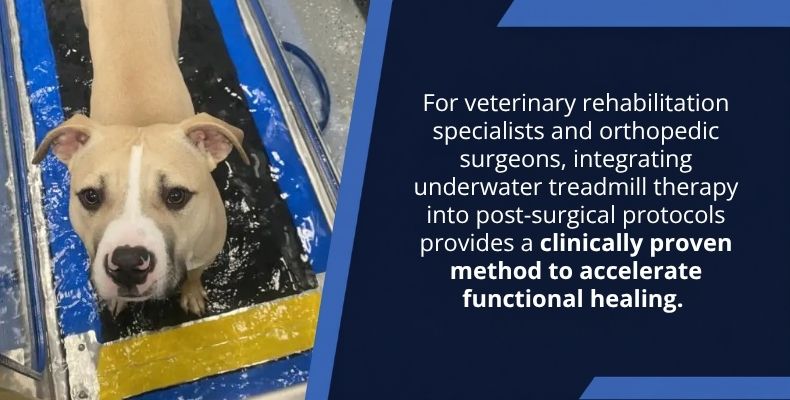
For veterinary rehabilitation specialists and orthopedic surgeons, integrating underwater treadmill therapy into post-surgical protocols provides a clinically proven method to accelerate functional healing. At HydroWorx, we engineered the HydroWorx K900 underwater treadmill specifically to meet the rigorous demands of canine rehabilitation, enabling veterinary professionals to restore joint range of motion, preserve lean muscle mass, and retrain symmetrical gait mechanics in a safe, low-impact environment.
The Prevalence of CCL Tears and Post-Surgical Atrophy in Dogs
The canine CCL plays a critical structural role in stabilizing the stifle joint, preventing cranial translation of the tibia relative to the femur, limiting internal rotation, and preventing hyperextension. When a rupture occurs—often driven by chronic ligamentous degeneration or acute mechanical trauma—the stifle loses its structural stability, leading to immediate inflammation, pain, and non-weight-bearing lameness.
Following corrective orthopedic surgery, a major race against time begins regarding disuse muscle atrophy. Severe atrophy of the ipsilateral quadriceps, hamstrings, and gluteal muscle groups can begin within days of immobilization or limb favorship. Furthermore, prolonged non-weight-bearing behavior leads to joint capsule tightness, reduced synovial fluid circulation, and cartilage degradation. Traditional land-based cage rest and controlled leash walking, while necessary for initial bone healing, often fall short of providing the active, low-impact mechanical loading required to preserve muscle volume and maintain stifle joint health.
Adjusting Water Depth: Modulating Weight-Bearing Loads for Safe Limb Usage
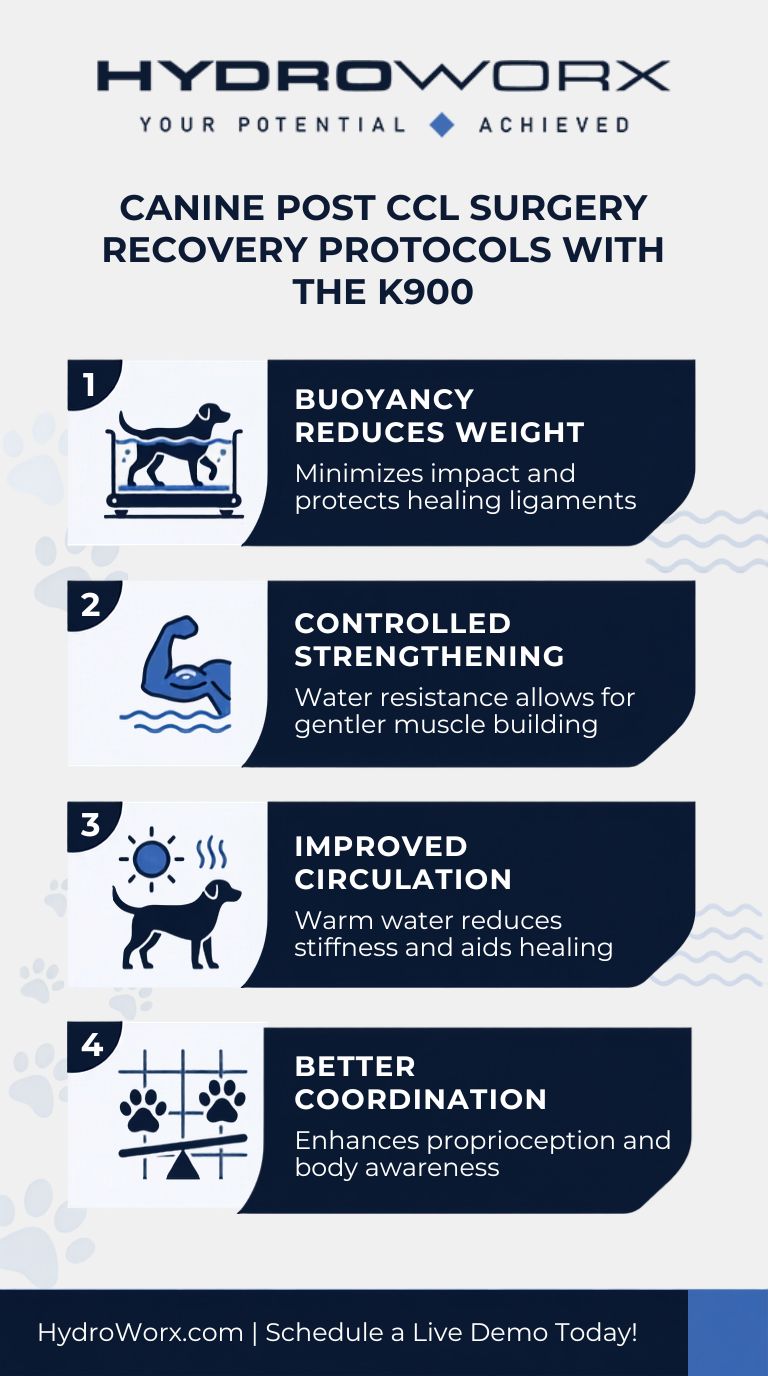
The foundation of successful canine aquatic rehabilitation lies in the precise manipulation of buoyancy through water depth adjustment. By submerging the patient to specific anatomical landmarks, veterinary hydrotherapists can meticulously control the amount of body weight supported by the water, encouraging early limb placement without threatening surgical repair integrity:
- Water Level at Greater Trochanter (Hip): Reduces weight-bearing load by approximately 60% to 75%. This depth is ideal for early post-operative stages, allowing dogs to perform gentle, unweighted limb movement with minimal joint compression.
- Water Level at Stifle (Knee): Reduces weight-bearing load by approximately 38% to 50%. This mid-stage depth offers an optimal balance between buoyant assistance and controlled mechanical loading, stimulating bone remodeling and muscle contraction.
- Water Level at Hock (Ankle): Reduces weight-bearing load by approximately 15% to 25%. Used in late-stage rehabilitation to transition the canine patient back to full land-based impact forces.
Initiating early, partial weight-bearing exercise on the underwater treadmill stimulates mechanoreceptors within the joint, promoting the secretion of lubricating synovial fluid and preventing intra-articular adhesions. The soothing warmth of the water (typically maintained between 84°F and 90°F) further enhances regional blood flow, relaxes guarding musculature, and alleviates post-surgical discomfort, giving the canine patient the confidence to place the operative paw on the treadmill belt weeks before they would comfortably walk on land.
Speed Progression & Visual Feedback via K900 Viewing Windows
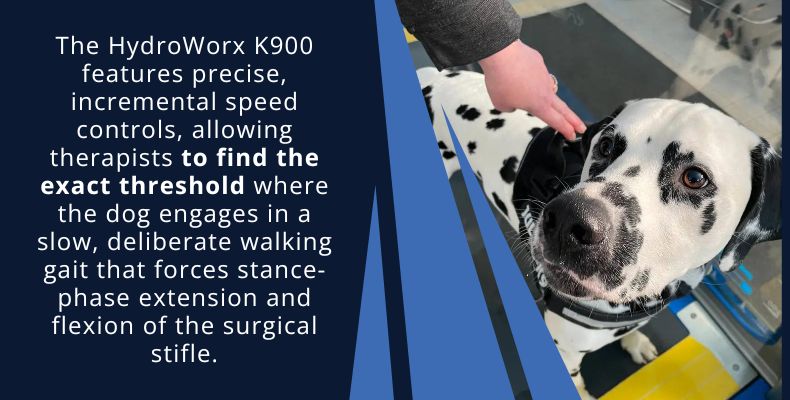
Gait retraining after CCL surgery requires fine control over belt acceleration and speed duration. Moving too quickly can induce a trotting gait where the dog continues to non-weight-bear or hop on three legs; moving too slowly may encourage improper stance mechanics. The HydroWorx K900 features precise, incremental speed controls, allowing therapists to find the exact threshold where the dog engages in a slow, deliberate walking gait that forces stance-phase extension and flexion of the surgical stifle.
A critical advantage of the HydroWorx K900 is its multi-angle, clear viewing glass windows. These transparent side panels allow veterinary clinicians to perform real-time visual gait analysis throughout the rehabilitation session. Therapists can continuously monitor:
- Stifle Extension & Flexion Angles: Ensuring the dog is reaching full extension during the push-off phase rather than circumducting or short-stepping.
- Paw Placement & Tracking: Observing whether the surgical paw strikes the belt squarely or exhibits knuckling, abducting, or turning inward.
- Symmetry of Stride: Comparing the stance-phase duration of the operated leg against the contralateral limb to detect subtle weight-shifting habits.
If gait abnormalities are detected through the viewing windows, the therapist can immediately pause, adjust water depth, modify belt speed, or provide manual guidance to correct the movement pattern before improper motor habits become ingrained.
Preventing Contralateral Limb Stress During Recovery
A frequently overlooked danger in canine CCL rehabilitation is the immense mechanical stress placed on the non-injured contralateral hind limb. Up to 40% to 60% of dogs that suffer a unilateral CCL tear will eventually rupture the CCL in the opposing leg within 1 to 2 years. This high secondary injury rate is significantly driven by severe compensatory weight shifting during the initial recovery period.
When a dog favors its surgical leg on land, the opposite hind limb bears an unnatural percentage of the animal’s total body weight, drastically accelerating degenerative wear on its ligamentous structures. Aquatic therapy directly mitigates this compensatory overload. By supporting the patient’s body weight in water, the HydroWorx K900 allows equal, balanced weight distribution across all four limbs during locomotion. This preserves the structural integrity of the healthy knee while simultaneously rebuilding symmetrical strength across both hindquarters.

Elevating Veterinary Practice Standards and Patient Outcomes
For modern veterinary hospitals, specialty surgical centers, and dedicated canine rehabilitation practices, offering state-of-the-art hydrotherapy elevates the overall quality of care and sets the facility apart in a competitive market. Integrating the HydroWorx K900 into post-CCL surgical protocols transforms recovery from a passive waiting game into an active, objective, and rewarding healing process. By providing precise buoyancy control, clear visual diagnostic capabilities, and warm-water pain relief, veterinary professionals can significantly shorten return-to-function timelines, minimize long-term arthritic changes, and ensure four-legged patients return to active, happy lives alongside their families. To learn more about the HydroWorx K900 or to schedule a demo, reach out to our team today.