
Tactical athletes—including military service members, law enforcement officers, and firefighters—operate under physical demands that rival, and often exceed, those of elite professional sports. Their daily operational environments require carrying heavy body armor, performing explosive structural entries, navigating unpredictable terrain, and enduring prolonged physical stress.
When an injury strikes a tactical athlete, the primary objective is not merely symptom reduction; it is achieving a safe, rapid return-to-duty (RTD) without compromising long-term operational readiness or unit strength. Integrating specialized aquatic therapy into military and first responder rehabilitation programs provides physical therapists, human performance directors, and athletic trainers with an unparalleled clinical tool to bridge the gap between initial injury and full operational deployment. At HydroWorx, we engineer research-backed aquatic therapy solutions specifically designed to accelerate these critical rehabilitation timelines and keep our nation’s defenders operating at peak performance.

The Biomechanical Demands and Micro-Traumatic Risks of the Tactical Environment
Unlike traditional athletes whose physical stress is confined to controlled playing fields and scheduled seasons, tactical personnel experience continuous, high-impact loads in dynamic, high-stress conditions. A fully equipped patrol officer or active-duty soldier routinely carries anywhere from 30 to 80 pounds of external load in gear, plate carriers, tactical boots, and weaponry. Over time, this cumulative weight distribution places immense micro-traumatic stress on the lower extremities, lumbar spine, and supporting soft tissues.
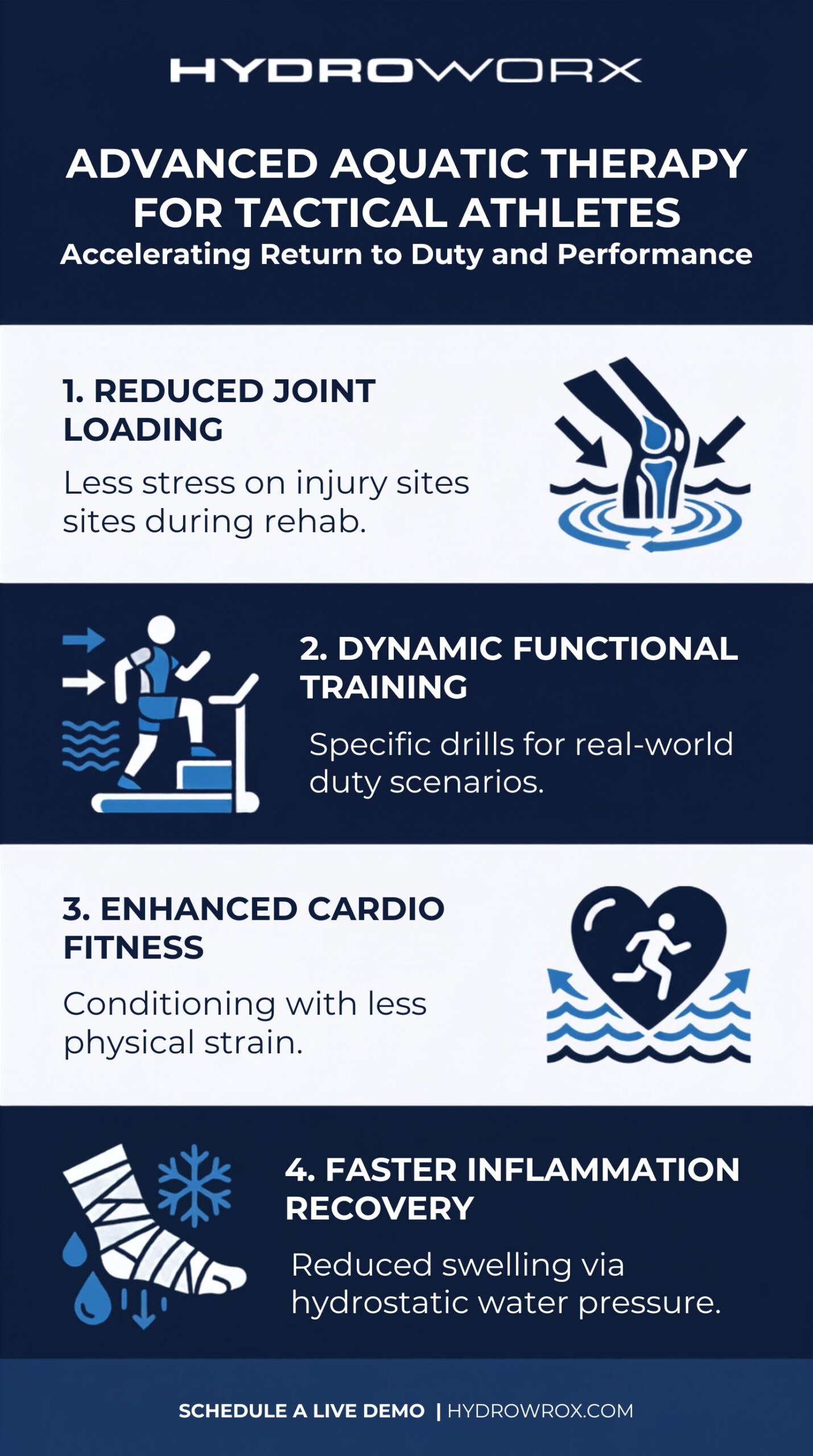
When acute injuries occur—such as anterior cruciate ligament (ACL) tears, meniscal damage, spinal disc compression, or complex ankle fractures—traditional land-based physical therapy often encounters a major bottleneck: weight-bearing limitations and pain-inhibited movement. Attempting to retrain functional movement patterns on land while managing acute joint inflammation and altered gait mechanics frequently delays early intervention. Aquatic therapy eliminates this barrier by leveraging hydrostatic pressure and buoyancy. By unweighting the body in a controlled aquatic environment, clinicians can initiate multi-planar movement patterns weeks earlier than land-based protocols safely permit, preserving muscle mass and neural pathways that would otherwise atrophy during prolonged periods of immobility.
Simulating Loaded Movement Mechanics in a Reduced-Impact Setting
One of the greatest clinical challenges in tactical rehabilitation is transitioning an injured operator from basic, unloaded mobility exercises to heavy, load-bearing tasks required on duty. HydroWorx underwater treadmill systems allow physical therapists to precisely control and adjust the patient’s weight-bearing status based on water depth:
-
Chest-Deep Water: Reduces body weight and joint impact load by approximately 75%
-
Waist-Deep Water: Reduces body weight and joint impact load by approximately 50%
By modulating water depth, clinicians can introduce early gait retraining and functional movement patterns—such as lateral shuffling, tactical deceleration, low-crawling mechanics, and dynamic pivot drills—without overloading healing joint cartilage or delicate surgical repairs.
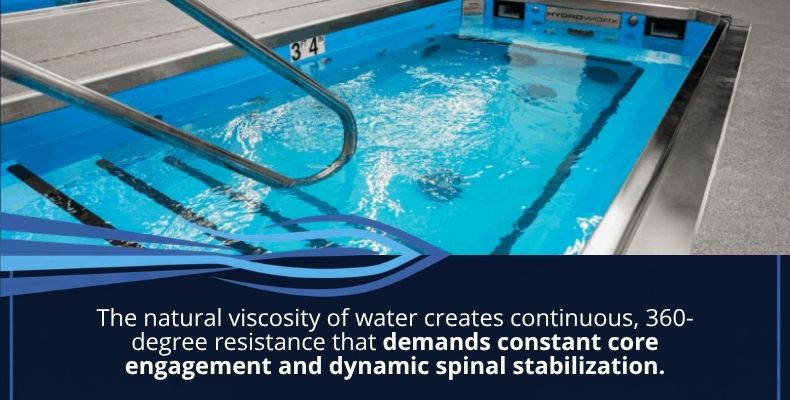
As the recovery process advances, aquatic therapy enables clinicians to simulate real-world tactical stresses safely and progressively. The natural viscosity of water creates continuous, 360-degree resistance that demands constant core engagement and dynamic spinal stabilization. This allows the operator to rebuild tactical endurance, cardiovascular stamina, and functional strength while protecting vulnerable joints from secondary impact trauma or force spikes.
Utilizing High-Resistance Jet Systems for Explosive Power and Gait Analysis
Modern tactical operations demand multidirectional agility, explosive power, and exceptional aerobic capacity. Once acute tissue healing is well-established, aquatic rehab transitions from mobility restoration to high-intensity conditioning and sport-specific tactical training.
Integrated directional water jets provide controllable, high-volume resistance against which operators can perform explosive forward pushes, high-knee drives, heavy drag maneuvers, and combat-style swimming drills. Because water resistance scales exponentially with effort—meaning the harder and faster the athlete pushes, the greater the resistance the water generates—operators can achieve maximal muscular activation and power production without the harsh deceleration forces that cause joint wear on land.
Furthermore, integrated underwater cameras and viewing windows provide physical therapy teams with real-time diagnostic visual feedback. Clinicians can monitor gait symmetry, stride length, limb propulsion, and subtle compensation patterns that might otherwise go unnoticed during traditional land-based return-to-duty testing. Correcting these biomechanical flaws underwater ensures the operator builds a structurally sound foundation before returning to high-impact land drills, heavy ruck marches, or tactical agility courses.
Central Nervous System Reset: Autonomic Balance and Active Recovery
Physical trauma, paired with the high-stress nature of tactical professions, frequently leaves the autonomic nervous system in a chronic state of sympathetic overload (“fight or flight”). Prolonged sympathetic dominance elevates systemic cortisol levels, increases systemic inflammation, disrupts sleep architecture, and impairs cellular tissue repair.
Aquatic therapy serves a dual purpose by facilitating active physical recovery and down-regulating the sympathetic nervous system:
-
Hydrostatic Pressure: Applying uniform, ambient hydrostatic pressure across the entire submerged body increases peripheral circulation, enhances venous return to the heart, and aids in the rapid clearance of metabolic waste and localized post-injury edema.
-
Parasympathetic Activation: Warm water therapy (typically maintained between 88°F and 92°F) promotes systemic vasodilation, reduces chronic muscle guarding, and triggers a strong parasympathetic response that lowers resting heart rate and reduces stress-induced muscle tension.
-
Targeted Hydromassage: Deep-tissue massage jet attachments enable clinicians to target tight fascia, trigger points, and stubborn post-surgical scar tissue directly, thereby improving soft-tissue elasticity and range of motion before functional training sessions.

Partnering with HydroWorx to Protect Those Who Protect Us
For tactical human performance centers, Veterans Affairs medical facilities, occupational health clinics, and military medical bases, reducing time-loss injuries is directly linked to operational readiness and unit capability. Incorporating advanced aquatic technology empowers clinicians to deliver progressive, objective, and aggressive rehabilitation protocols that safeguard operators against premature re-injury. At HydroWorx, we remain dedicated to engineering innovative underwater treadmills and therapy pools that set the gold standard in physical rehabilitation, helping military personnel and first responders return to duty stronger, faster, and more resilient than before. To learn more about our hydrotherapy pool options or to schedule a demo, contact us today.